




Elevate Your Everyday with Effortless Elegance
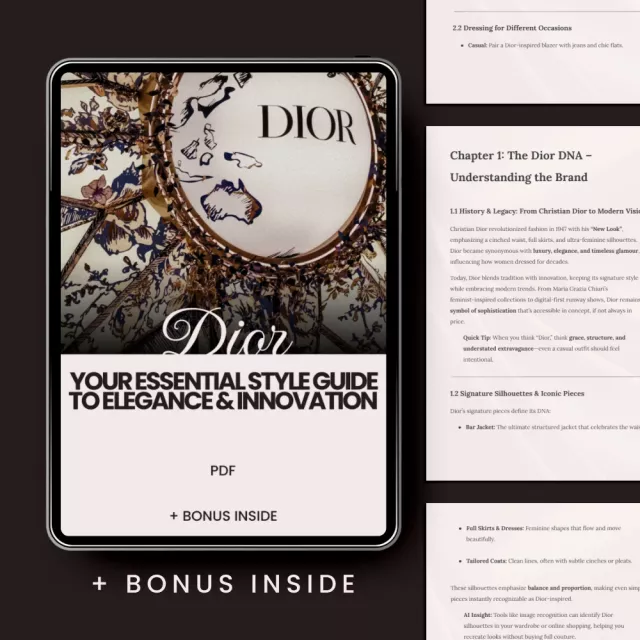
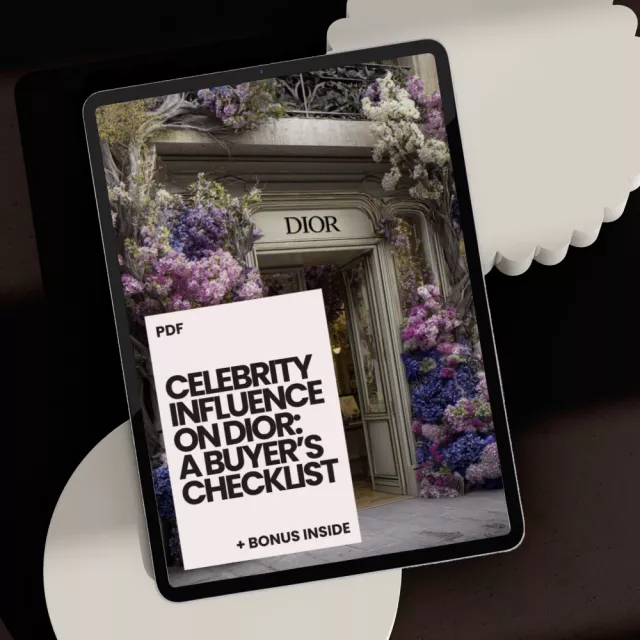
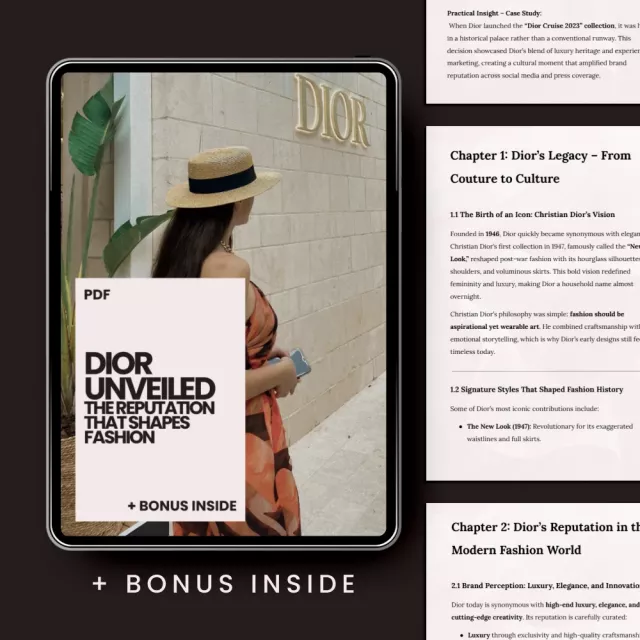
Have you ever admired the polished confidence of a Dior-inspired look and wondered how to make it work in real life? Dior Lifestyle Fit: Your Style, Simplified is your complete digital roadmap to understanding and applying the dior lifestyle fit explained simply — without feeling overwhelmed, overdressed, or out of budget. This beautifully structured ebook breaks down luxury style into clear, practical steps you can follow immediately.
Whether you’re building your first refined wardrobe or refining an existing one, this guide shows you how to align your clothing, accessories, and daily habits with a cohesive Dior-inspired aesthetic that feels natural and authentic to you.
What’s Inside This eBook
- Clear explanation of what the Dior Lifestyle truly means and why your lifestyle fit matters
- Breakdown of Dior aesthetic basics: signature colors, patterns, and iconic design elements
- Guidance on dressing for casual, professional, and evening settings
- Step-by-step instructions for building a versatile Dior-inspired wardrobe
- Tips for mixing Dior with non-luxury brands effortlessly
- Accessory styling: handbags, jewelry, watches, shoes, and sneakers
- Common style mistakes and how to avoid them
- How to use AI outfit planners and tools to curate your Dior lifestyle
- Strategies for creating a long-term Dior capsule wardrobe and lifestyle vision
Why You’ll Love This Guide
- Designed for beginners and fashion lovers alike
- Written in simple, approachable language
- Focused on real-life wearability, not just runway inspiration
- Helps you avoid expensive styling mistakes
- Encourages smart investment pieces and seasonal updates
- Combines classic fashion principles with modern AI styling tools
Who Is This For?
This ebook is perfect for aspiring luxury fashion enthusiasts, professionals seeking a polished wardrobe, content creators building a refined personal brand, and anyone who wants dior lifestyle fit explained simply without complicated fashion jargon.
Unlike generic fashion guides, this resource focuses specifically on translating the Dior aesthetic into practical, wearable outfits tailored to your daily routine. It goes beyond trends and teaches you how to build a lifestyle — not just a look.
Start Your Dior Journey Today
Luxury style doesn’t have to be confusing or unattainable. With Dior Lifestyle Fit: Your Style, Simplified, you’ll gain clarity, confidence, and a curated plan to elevate your wardrobe with intention.
Download your copy today and begin transforming your personal style into a timeless, Dior-inspired lifestyle that truly fits you.
SHIPPING
We are proud to offer international shipping services that currently operate in over 200 countries and islands world wide. Nothing means more to us than bringing our customers great value and service. We will continue to grow to meet the needs of all our customers, delivering a service beyond all expectation anywhere in the world.
Do you ship worldwide?
Yes. We provide free shipping to over 200 countries around the world. However, there are some locations we are unable to ship to. If you happen to be located in one of those countries we will contact you.
What about customs?
We are not responsible for any custom fees once the items have been shipped. By purchasing our products, you consent that one or more packages may be shipped to you and may get custom fees when they arrive to your country.
How long does shipping take?
Shipping time varies by location. These are our estimates:| Location | *Estimated Shipping Time |
|---|---|
| United States | 5-20 Business days |
| Canada, Europe | 5-20 Business days |
| Australia, New Zealand | 5-20 Business days |
| Central & South America | 5-25 Business days |
| Asia | 5-20 Business days |
| Africa | 5-25 Business days |
Do you provide tracking information?
Yes, you will receive an email once your order ships that contains your tracking information. If you haven’t received tracking info within 5 days, please contact us.
My tracking says “no information available at the moment”.
For some shipping companies, it takes 2-5 business days for the tracking information to update on the system. If your order was placed more than 5 business days ago and there is still no information on your tracking number, please contact us.
Will my items be sent in one package?
For logistical reasons, items in the same purchase will sometimes be sent in separate packages, even if you've specified combined shipping.
If you have any other questions, please contact us and we will do our best to help you out.
RETURNS
Order cancellation
All orders can be cancelled until they are shipped. If your order has been paid and you need to make a change or cancel an order, you must contact us within 12 hours. Once the packaging and shipping process has started, it can no longer be cancelled.
Refunds
Your satisfaction is our #1 priority. Therefore, you can request a refund or reshipment for ordered products if:
- If you did not receive the product within the guaranteed time (45 days not including 1-3 day processing) you can request a refund or a reshipment.
- If you received the wrong item you can request a refund or a reshipment.
- If you do not want the product you’ve received you may request a refund but you must return the item at your expense and the item must be unused.
We do not issue the refund if:
- Your order did not arrive due to factors within your control (i.e. providing the wrong shipping address)
- Your order did not arrive due to exceptional circumstances outside the control of cresteri.com (i.e. not cleared by customs, delayed by a natural disaster).
- Other exceptional circumstances outside the control of cresteri.com.
*You can submit refund requests within 15 days after the guaranteed period for delivery (45 days) has expired. You can do it by sending a message on Contact Us page
If you are approved for a refund, then your refund will be processed, and a credit will automatically be applied to your credit card or original method of payment, within 14 days.
Exchanges
If for any reason you would like to exchange your product, perhaps for a different size in clothing, you must contact us first and we will guide you through the steps.
Please do not send your purchase back to us unless we authorise you to do so.
Order cancellation
All orders can be cancelled until they are shipped. If your order has been paid and you need to make a change or cancel an order, you must contact us within 12 hours. Once the packaging and shipping process has started, it can no longer be cancelled.
Refunds
Your satisfaction is our #1 priority. Therefore, you can request a refund or reshipment for ordered products if:
- If you did not receive the product within the guaranteed time( 45 days not including 2-5 day processing) you can request a refund or a reshipment.
- If you received the wrong item you can request a refund or a reshipment.
- If you do not want the product you’ve received you may request a refund but you must return the item at your expense and the item must be unused.
We do not issue the refund if:
- Your order did not arrive due to factors within your control (i.e. providing the wrong shipping address)
- Your order did not arrive due to exceptional circumstances outside the control of cresteri.com (i.e. not cleared by customs, delayed by a natural disaster).
- Other exceptional circumstances outside the control of https://cresteri.com
*You can submit refund requests within 15 days after the guaranteed period for delivery (45 days) has expired. You can do it by sending a message on Contact Us page
If you are approved for a refund, then your refund will be processed, and a credit will automatically be applied to your credit card or original method of payment, within 14 days.
Exchanges
If for any reason you would like to exchange your product, perhaps for a different size in clothing. You must contact us first and we will guide you through the steps.
Please do not send your purchase back to us unless we authorise you to do so.
Customer Reviews
Write a Review
We Think You’ll Love
Top picks just for you











The anchor pieces vs. flex pieces framework from Chapter 8 changed how I shop.
Professional Dior is the chapter I didn't know I needed — the beige blazer with a matching tote concept immediately earns its place in any working wardrobe. Section 1.3's advice to start by mapping your weekly activities before buying anything is the grounding step most style guides skip entirely. I used it to realize that three of my recent Dior purchases were better suited to a life I aspired to than the one I actually live, and then I started over with a clearer brief.
✨
I've spent years collecting Dior pieces without any real system, and this guide was the first resource that gave me a coherent framework rather than just a collection. Chapter 1's distinction between adopting a philosophy of elegance versus simply wearing a logo reoriented how I think about every purchase. The lifestyle fit concept in Section 1.3 — matching pieces to your actual weekly activities rather than aspirational ones — is the most honest piece of advice in the whole guide. Chapter 6's Sarah case study, where she overdressed for a casual brunch by combining a Lady Bag, Dior heels, scarf, and earrings simultaneously, resonated immediately because I had made almost exactly that mistake at a friend's garden party the summer before. The fix is simple: one statement piece per outfit, let the rest support it. Reading chapters 3 through 6 in sequence gives you a complete picture of how the same Dior pieces work across casual, professional, and evening contexts without requiring an entirely different wardrobe for each.
Chapter 6's one-statement-piece rule solved my over-accessorizing problem immediately.
Mixing Dior with Zara and Uniqlo is advice I'd heard before, but Section 4.2 is the first place I've seen it explained as a structural principle rather than a budget compromise. The idea that Dior pieces stand out more when they're anchors surrounded by neutral, well-fitting non-luxury pieces rather than competing with other statement items resolved a tension I'd felt in my wardrobe for years. Building from classic neutrals toward Dior's signature pastels and jewel tones, as the Chapter 2 color palette suggests, gives a methodology to what had previously felt like trial and error.
Dior sneakers, Saddle Bag, cashmere sweater — the casual chapter's everyday luxury example is exactly right.
The chapters on wardrobe building and occasion-based dressing — specifically the professional Dior and casual everyday sections in Chapter 3 — are the strongest content in the guide, clear and immediately actionable. Chapter 7's AI section has good instincts but stays surface-level, naming tools without showing how to integrate them into a real decision-making process alongside the anchor-and-flex framework the rest of the guide establishes. Four stars because those early chapters earn them and the AI content is the only place the depth doesn't match.
Map your weekly activities first — Chapter 1's lifestyle fit advice is exactly right ✨
My approach to building a Dior wardrobe used to be entirely reactive — buying what caught my eye in the moment without any long-term structure, which meant pieces sat unworn because nothing else in my wardrobe spoke the same language. Chapter 4's seasonal investment framework changed that entirely. The advice to plan one to two investment pieces per season around a neutral core foundation gave me a pacing structure that made the whole collection feel achievable rather than overwhelming. The spring and winter case studies in Section 4.3 — a pastel Dior scarf with neutral basics in warmer months, a structured coat and pumps elevating neutral layers in colder ones — showed me how one wardrobe foundation adapts across seasons without constant replacement. The mixing guidance in Section 4.2, where Dior heels with Zara trousers and a Dior bag over a Uniqlo cashmere sweater become the examples, gave me permission to treat my existing wardrobe as context rather than something to replace. I now run a wardrobe audit at the start of each season using the Chapter 4 framework, marking which pieces are compatible with a Dior aesthetic and planning the next addition accordingly.
The Section 5.1 tip — choose one signature Dior bag per season to anchor your outfits — sounds almost too simple until you apply it and realize how much wardrobe confusion it eliminates. Cycling between the Lady Dior, Saddle Bag, and Book Tote across different seasons and contexts honors each piece while giving each its appropriate role rather than asking one bag to carry all functions. The note that other items should complement rather than compete with the season's anchor bag is the organizing principle the whole accessories chapter builds from.
Chapter 5's jewelry section needed more depth on mixing subtle and statement pieces.
Chapter 1's philosophy reorients every purchase decision before you even consider a specific piece.
The Sarah case study in Chapter 6 does more work than a case study usually does — it shows how individual Dior pieces that each merit compliments can collectively overwhelm an outfit when worn together. The fix, selecting one dominant piece and letting the rest recede, is stated simply but requires genuine discipline to apply consistently. The portable version of that lesson — asking whether each item matches the occasion's tone — is the question I now run through every morning.
This guide treats Dior as a philosophy to inhabit rather than a product range to consume, and that framing is present in every chapter including the ones you might expect to be purely practical. The professional Dior section in Chapter 3 is a masterclass in restrained luxury — a beige blazer over a silk blouse with Dior pumps and a matching tote communicates sophistication without announcing a price tag, which is the exact 'without shouting luxury brand alert' distinction the guide makes explicitly. Chapter 8's lifestyle habits section is where the guide reaches its fullest expression, arguing that Dior's attention to detail extends to how you organize your wardrobe, host guests, and approach meetings, not just what you wear — I had to read that section twice before it settled. The Section 1.3 practical tip about mapping weekly activities before selecting pieces is the most immediately actionable exercise in the guide and the one I returned to several times as I worked through the later chapters. Chapters 3, 6, and 8 read most coherently in sequence: occasion-appropriate dressing, then the mistakes that disrupt it, then the lifestyle integration that makes the whole practice sustainable.
The anchor versus flex distinction from Chapter 8 finally explains how luxury and high-street mixing works.
Chapter 7's AI outfit planning section is the most practical integration of technology and personal style I've found in a fashion guide. The virtual try-on concept — seeing how Dior bags, shoes, and clothing look with your existing wardrobe before committing — is particularly valuable at luxury price points where a mistake is genuinely costly. Using calendar and weather data to generate daily outfit suggestions across work, casual, and evening contexts, as Section 7.1 describes, is what brings the whole lifestyle framework from aspirational to daily.
The lifestyle fit framework from Chapter 1 and the occasion-based dressing in Chapter 3 give the guide a genuinely useful structure, and the anchor-versus-flex distinction from Chapter 8 is one of the clearest ideas in any fashion guide I've encountered. Where it loses credibility is Chapter 7 — naming AI tools without explaining how to evaluate whether their suggestions align with your established Dior aesthetic, rather than just your browsing history, leaves the guide's most forward-looking chapter as its thinnest. The core wardrobe building content earns the download; the AI sections would benefit from the same depth the fashion chapters receive.
Section 2.1's breakdown of Dior's design language into structured silhouettes, soft femininity, and luxury materials like cashmere, silk, and lambskin gives you a vocabulary to evaluate pieces before you're ever in a boutique, which is precisely the preparation that prevents expensive impulse decisions. The Dior Oblique monogram and floral motifs discussed in Section 2.2 are described as coherent brand identifiers alongside the neutral color palette, showing how recognizability and restraint coexist in the same visual language. Understanding how those elements interact makes it considerably easier to evaluate which pieces read as authentically Dior and which simply carry the logo.
For two years I owned a Lady Dior bag, a pair of Dior sneakers, and two silk blouses that I wore infrequently because nothing else in my wardrobe connected with them, and I couldn't identify why. Chapter 4's wardrobe audit exercise was the first thing I completed after finishing the guide, and it immediately revealed the problem: I had been buying aspirationally rather than practically. Marking which existing pieces were compatible with a Dior aesthetic and which were working against it showed me that the issue wasn't the Dior pieces but the surrounding context. Section 4.2's examples — Dior heels with Zara trousers, a Dior bag over a Uniqlo cashmere sweater — gave me permission to treat my existing wardrobe as flex pieces rather than replacing it entirely. The seasonal investment pacing in Section 4.3, introducing one to two new pieces per season while maintaining the neutral foundation, transformed what had felt like an overwhelming project into a manageable long-term one. Chapter 2's signature color guidance, building from black, white, gray, and beige before introducing the pastels and jewel tones as personality layers, is the sequencing advice I needed before my first Dior purchase.
Luxury is curating life with intention — that's the whole point of Chapter 8
Evening Dior in Section 3.3 is handled elegantly — the gala example of a little black dress with Dior heels, matching clutch, and a single delicate bracelet demonstrates the guide's central restraint principle at its most formal. Dramatically elegant pieces like satin gowns and metallic accents set the right register, but the emphasis on one signature accessory keeping the look luxurious rather than overwhelming is what distinguishes Dior eveningwear from simple occasion dressing. The AI tip to use trend prediction tools for seasonally popular evening pieces adds a planning dimension to what would otherwise be entirely backward-looking advice.
The wardrobe building chapters — Section 4.1's must-have staples and Section 4.2's mixing strategy — are the strongest content in the guide. The tailored silhouette emphasis in the professional Dior section is correct but assumes the reader already has well-fitting clothing as a baseline; a brief section on applying Dior's tailored approach to having existing pieces adjusted rather than replaced would strengthen the guide considerably. Four stars because the core framework is genuinely useful and the seasonal investment pacing in Section 4.3 is practical advice that works across income levels.
Build neutral first, introduce Dior colors second — Chapter 4's sequencing advice is exactly correct.
I need to describe a complete before/after here because this guide produced a genuine one. For two years I treated Dior as a collection to accumulate rather than a lifestyle to inhabit, which cost me several poorly considered purchases — a Lady Dior bag I wore once a month, Dior sneakers I reserved for occasions special enough to 'deserve' them, and two silk blouses from Section 4.1's clothing staples list that never made it into actual rotation because nothing else in my wardrobe spoke the same language. Chapter 1's lifestyle fit concept was the first thing I genuinely applied: Section 1.3's exercise of mapping your weekly activities — three client meetings, two casual lunches, and weekend family time in my case — against what I'd purchased revealed that I had been building toward an aspirational schedule rather than my actual one. That realization alone reoriented my next three purchase decisions. Working through Chapter 3's occasion framework against my real calendar showed me that a beige blazer and the Book Tote were the two pieces most likely to earn daily wardrobe presence, not the Lady Dior, which belongs to a version of my life I'm still building toward. Chapter 6's Sarah case study was uncomfortably accurate — I had assembled similarly over-accessorized outfits not from ignorance of the less-is-more principle but because I had no framework for applying it in the moment, and the one-statement-piece question is now the first thing I ask when getting dressed. Chapter 4's mixing strategy — Dior heels with Zara trousers, Dior bag over Uniqlo cashmere — gave me explicit permission to integrate my existing wardrobe as flex pieces around my Dior anchors rather than waiting until I had enough Dior pieces to fill every slot. Chapter 8's anchor versus flex framework named that permission and made it structural: my Lady Dior is an anchor, my current blazers and trousers are flex, and the system only works when those categories are clear. Section 8.2's habits beyond fashion — tailoring your clothes, maintaining grooming, approaching meetings with polished confidence, hosting with refined attention to detail — extended the guide's value past clothing entirely, and that's where it earned the extra-long review.