



Unlock the Secrets of Celebrity Fashion with Dior
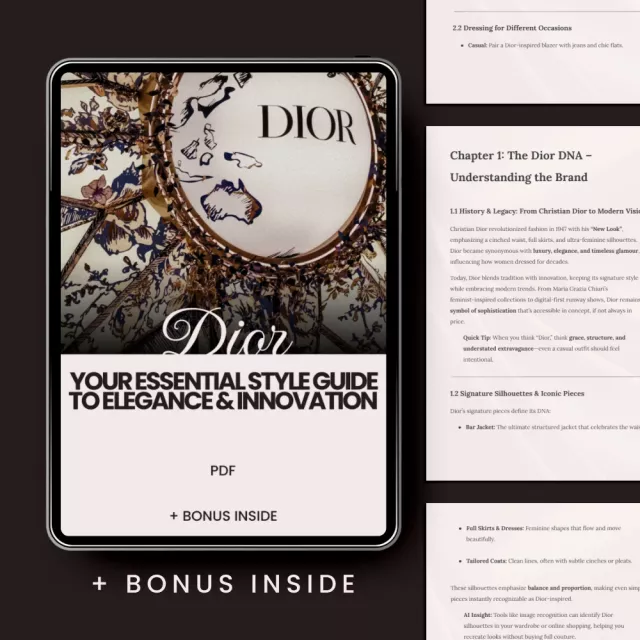
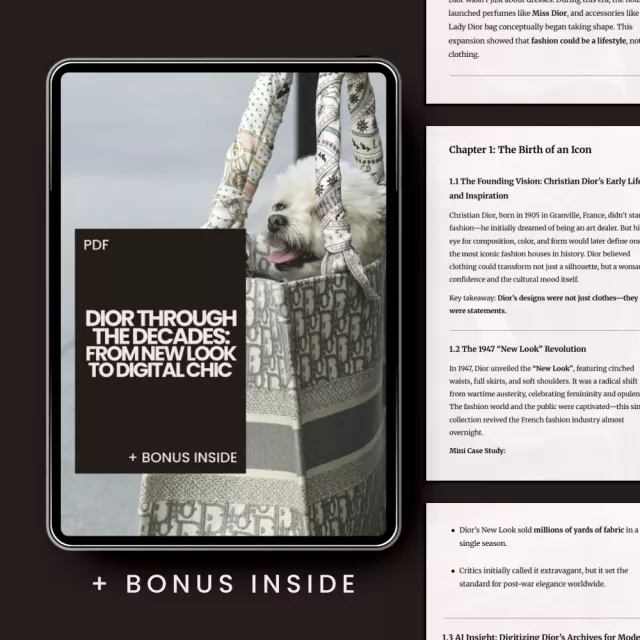
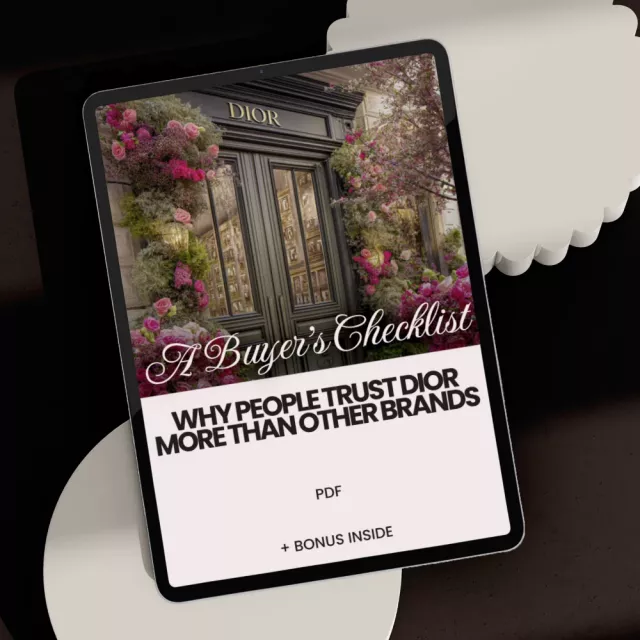
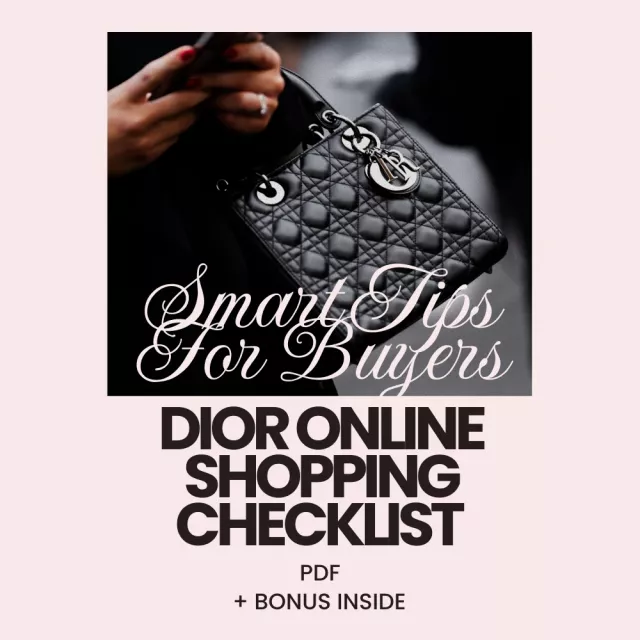
Want to know how celebrity fashion impacts your Dior choices? Whether you’re a seasoned buyer or a newcomer to high-end style, understanding how celebrity influence shapes the fashion world can give you an edge. Our Celebrity Influence on Dior: A Buyer’s Checklist is a step-by-step guide that helps you spot trends, evaluate celebrity endorsements, and make informed decisions when choosing Dior pieces. Perfect for those looking to elevate their fashion game or dive into the world of luxury fashion, this digital download is your key to understanding how the stars influence the choices you make.
What’s Inside the Checklist?
- Spot the Trends: Track which Dior pieces are taking over the red carpet and major events.
- Evaluate Endorsements: Learn how celebrity collaborations and endorsements affect Dior’s desirability.
- Assess Social Media Impact: Find out how social media plays a role in shaping public opinion on Dior items.
- Analyze Seasonal Choices: Compare celebrity fashion choices during fashion weeks and street style to spot lasting trends.
- Factor in Exclusivity: Learn why limited editions and rare items create buzz and increase resale value.
- Make Your Personal Style Connection: Discover how to balance trendy pieces with timeless Dior classics that suit your aesthetic.
Why You’ll Love This Checklist
The Celebrity Influence on Dior: A Buyer’s Checklist is not just a list—it’s a strategic guide to navigating the complex relationship between celebrity fashion and Dior choices. This checklist empowers you to make smart, informed decisions, helping you stay ahead of trends while ensuring that your purchases align with your personal style. It’s the perfect tool for anyone wanting to add a touch of celebrity glamour to their collection without compromising on quality or timeless appeal.
Practical Benefits
- Stay Ahead of Trends: Learn to spot which Dior pieces celebrities are wearing and why it matters.
- Make Smart Purchases: Know which collaborations and pieces are worth investing in before they hit the mainstream.
- Exclusive Insights: Get the inside track on limited edition items and how they can influence your buying decisions.
- Personal Style Guidance: Create a wardrobe that’s not only on-trend but also true to your unique taste.
Who Is This For?
This checklist is for anyone who wants to harness the power of celebrity influence to make better Dior choices. Whether you’re a seasoned collector, a fashion enthusiast, or a newcomer to the world of high-end style, this digital guide will help you understand the trends shaping Dior and how to shop smart. If you want to make purchases that stand out, appreciate the exclusivity of fashion, and align with current celebrity trends, this checklist is perfect for you.
Why Choose This Digital Download?
Unlike other resources, this checklist is uniquely focused on the intersection of celebrity fashion and Dior choices. It’s not just about following trends—it’s about making educated decisions and curating a timeless collection that reflects the latest influences in fashion. You’ll gain valuable insights into what makes certain Dior pieces more desirable, and how to stay on top of the latest celebrity-driven trends.
Ready to Elevate Your Dior Collection?
Don’t wait for the trends to pass you by. Get your copy of the Celebrity Influence on Dior: A Buyer’s Checklist today and start shopping smarter. This checklist is your personal roadmap to mastering the art of celebrity fashion and making your Dior choices with confidence.
SHIPPING
We are proud to offer international shipping services that currently operate in over 200 countries and islands world wide. Nothing means more to us than bringing our customers great value and service. We will continue to grow to meet the needs of all our customers, delivering a service beyond all expectation anywhere in the world.
Do you ship worldwide?
Yes. We provide free shipping to over 200 countries around the world. However, there are some locations we are unable to ship to. If you happen to be located in one of those countries we will contact you.
What about customs?
We are not responsible for any custom fees once the items have been shipped. By purchasing our products, you consent that one or more packages may be shipped to you and may get custom fees when they arrive to your country.
How long does shipping take?
Shipping time varies by location. These are our estimates:| Location | *Estimated Shipping Time |
|---|---|
| United States | 5-20 Business days |
| Canada, Europe | 5-20 Business days |
| Australia, New Zealand | 5-20 Business days |
| Central & South America | 5-25 Business days |
| Asia | 5-20 Business days |
| Africa | 5-25 Business days |
Do you provide tracking information?
Yes, you will receive an email once your order ships that contains your tracking information. If you haven’t received tracking info within 5 days, please contact us.
My tracking says “no information available at the moment”.
For some shipping companies, it takes 2-5 business days for the tracking information to update on the system. If your order was placed more than 5 business days ago and there is still no information on your tracking number, please contact us.
Will my items be sent in one package?
For logistical reasons, items in the same purchase will sometimes be sent in separate packages, even if you've specified combined shipping.
If you have any other questions, please contact us and we will do our best to help you out.
RETURNS
Order cancellation
All orders can be cancelled until they are shipped. If your order has been paid and you need to make a change or cancel an order, you must contact us within 12 hours. Once the packaging and shipping process has started, it can no longer be cancelled.
Refunds
Your satisfaction is our #1 priority. Therefore, you can request a refund or reshipment for ordered products if:
- If you did not receive the product within the guaranteed time (45 days not including 1-3 day processing) you can request a refund or a reshipment.
- If you received the wrong item you can request a refund or a reshipment.
- If you do not want the product you’ve received you may request a refund but you must return the item at your expense and the item must be unused.
We do not issue the refund if:
- Your order did not arrive due to factors within your control (i.e. providing the wrong shipping address)
- Your order did not arrive due to exceptional circumstances outside the control of cresteri.com (i.e. not cleared by customs, delayed by a natural disaster).
- Other exceptional circumstances outside the control of cresteri.com.
*You can submit refund requests within 15 days after the guaranteed period for delivery (45 days) has expired. You can do it by sending a message on Contact Us page
If you are approved for a refund, then your refund will be processed, and a credit will automatically be applied to your credit card or original method of payment, within 14 days.
Exchanges
If for any reason you would like to exchange your product, perhaps for a different size in clothing, you must contact us first and we will guide you through the steps.
Please do not send your purchase back to us unless we authorise you to do so.
Order cancellation
All orders can be cancelled until they are shipped. If your order has been paid and you need to make a change or cancel an order, you must contact us within 12 hours. Once the packaging and shipping process has started, it can no longer be cancelled.
Refunds
Your satisfaction is our #1 priority. Therefore, you can request a refund or reshipment for ordered products if:
- If you did not receive the product within the guaranteed time( 45 days not including 2-5 day processing) you can request a refund or a reshipment.
- If you received the wrong item you can request a refund or a reshipment.
- If you do not want the product you’ve received you may request a refund but you must return the item at your expense and the item must be unused.
We do not issue the refund if:
- Your order did not arrive due to factors within your control (i.e. providing the wrong shipping address)
- Your order did not arrive due to exceptional circumstances outside the control of cresteri.com (i.e. not cleared by customs, delayed by a natural disaster).
- Other exceptional circumstances outside the control of https://cresteri.com
*You can submit refund requests within 15 days after the guaranteed period for delivery (45 days) has expired. You can do it by sending a message on Contact Us page
If you are approved for a refund, then your refund will be processed, and a credit will automatically be applied to your credit card or original method of payment, within 14 days.
Exchanges
If for any reason you would like to exchange your product, perhaps for a different size in clothing. You must contact us first and we will guide you through the steps.
Please do not send your purchase back to us unless we authorise you to do so.
Customer Reviews
Write a Review
We Think You’ll Love
Top picks just for you














Official campaign collaborations and organic celebrity choices are completely different market signals.
Criterion five's point about rare celebrity-featured items driving resale premiums is something I've confirmed across multiple Dior purchases over two years. When a limited edition piece gets sustained visibility from a top-tier ambassador, the secondary market moves quickly and the premium doesn't drop easily — which means the advance tracking tip in that same section is genuinely time-sensitive advice rather than general good practice. The connection between criteria one and five — spotting which pieces are appearing consistently, then cross-referencing limited edition status — is the closest this guide gets to a resale investment framework
Two years ago I made an expensive mistake buying a Dior piece on the strength of a single high-profile red carpet appearance, paying secondary market premium, only to watch the resale value drop within the season when the style failed to migrate beyond that one celebrity moment. Criterion four's longevity question — will this trend last, or is it a fleeting red carpet moment? — is exactly the lesson I learned the hard way before this checklist gave it a name. The seasonal comparison between fashion week appearances and street style choices is the verification step I had been missing entirely. Criterion one's pattern-tracking advice would have saved that purchase if I'd had it. Criterion six on personal style alignment has since become my most-used criterion, because buying pieces that genuinely belong in your existing aesthetic produces far better long-term satisfaction than chasing what a specific celebrity wore at a specific event. This checklist would have made me a considerably smarter buyer from the start.
Engagement signals on ambassador posts are more predictive of demand than raw follower counts.
The celebrity influence framework here covers the right range — trend identification, endorsement evaluation, social media reading, seasonal analysis, exclusivity, and personal alignment all belong in a buyer's checklist and the guide includes them coherently. Criterion three on social media impact is where I'd push for more depth: monitoring likes, shares, and comments is correct but too surface-level for serious buyers who need to evaluate sentiment and comment quality rather than engagement volume. Still a strong structural foundation and more organized than most resources available on this topic.
Criterion six transforms a buyer into a curator rather than just a trend-follower.
Criterion two's evaluation framework treats celebrity endorsements as analytical data rather than aspirational association, which is the mindset shift that separates effective buyers from reactive ones. Audience crossover between music, film, and sports isn't just an interesting observation — it determines which buyer segments will compete for limited pieces, which directly affects demand timing and secondary market pricing. Reading endorsement patterns through this lens makes the social media monitoring in criterion three considerably more focused and actionable
Fashion week versus street style comparison is the longevity test hiding inside criterion four.
⭐⭐⭐⭐⭐
Criterion five's advice to stay ahead of drops and special collaborations in advance has real financial implications for buyers who act on it. The secondary market for celebrity-featured Dior exclusives moves faster than most buyers realize, and advance tracking isn't just good preparation — it determines whether you access a piece at retail or pay a significant premium after peak visibility has already driven secondary pricing upward. Combining criterion five's exclusivity analysis with criterion one's pattern-spotting gives you a reliably early signal about which upcoming pieces are worth prioritizing.
Will this trend last or is it a fleeting red carpet moment — the most valuable question here.
The first four criteria build a coherent analytical sequence for reading celebrity influence on Dior buying decisions, and criteria five and six bring it into practical territory around exclusivity and personal alignment. The social media assessment is the weakest section — advice to follow ambassador accounts and monitor engagement is correct but basic, and the micro-influencer observation deserved more tactical guidance on how to identify the right accounts and what signals within them are most predictive. Still among the more structured buyer frameworks available on the celebrity-luxury dynamic.
I've been buying Dior for about four years, and for the first two I had no system — purely reactive, buying based on editorial coverage or celebrity social media, with no framework for evaluating whether the signal I was responding to was durable or momentary. This checklist provided that framework. Criterion one on spotting trends through recurring appearances across multiple event types, rather than reacting to isolated moments, is the foundational discipline everything else in the guide builds on. Criterion three's micro-influencer insight changed my research routine most tangibly — monitoring smaller accounts that consistently lead niche seasonal trends before major ambassadors adopt them has given me meaningful lead time on limited pieces. Criterion five on exclusivity connected celebrity influence analysis to concrete market mechanics in a way that immediately affected how I time purchases relative to the secondary market. Criterion six on personal style alignment is where I now invest the most time, not because it's the most complex, but because it's the most honest discipline a consistent buyer can develop
Crossover appeal between celebrity categories is the demand signal most luxury buyers haven't mapped.
Criterion three's micro-influencer tip is ahead of where most luxury buyers are currently watching.
The checklist reframes celebrity influence from something that happens to buyers into something buyers can actively read and use. Criterion two's distinction between official campaign collaborations and ambient celebrity association is the most important technical point — one is curated brand strategy, the other is organic market signal, and each requires different evaluation approaches. Reading both correctly, as criteria one through three collectively teach, gives a significantly more layered picture of where demand is actually moving rather than where it appears to be.
Criteria one and five work especially well together — tracking which pieces appear consistently on high-profile celebrities and connecting those patterns to limited edition status and resale potential gives a practical investment lens on the Dior market. Criterion six's placement at the end as a corrective to pure trend-following is well-considered, and the advice to balance trend-driven purchases with timeless classics is right. The seasonal analysis criterion is the least developed of the six; the longevity question it raises deserves substantially more space given how central that judgment is to avoiding expensive mistakes.
Celebrity-featured rare pieces driving resale value — criterion five is the collector-investor's whole checklist.
✨
When I started building my Dior collection three years ago, I had no framework for evaluating celebrity influence beyond recognizing names I already knew and assuming their association automatically validated a purchase. The first hard lesson came when I bought a heavily promoted piece based on a single award show appearance, paid above retail, and watched demand evaporate within two months when the celebrity's relationship with the brand turned out to be a one-off rather than a sustained partnership. Criterion two on evaluating endorsements addresses that mistake directly — the distinction between official campaign collaborations and single event appearances is fundamental, and the crossover appeal point helped me understand that the breadth of a celebrity's influence across buyer segments matters as much as the height of their profile. Criterion one on spotting trends taught me to think in accumulating patterns rather than individual moments — tracking recurring appearances of a specific bag or shoe across multiple event types before committing is a discipline that produces significantly better decisions than reactive buying. Criterion three changed my research workflow most tangibly: I now monitor comment quality on ambassador posts rather than aggregate engagement counts, and I follow several micro-influencer accounts that have consistently led niche Dior trends before major ambassadors arrived. Criterion four's seasonal comparison between fashion week and street style appearances formalized an instinct I had been developing informally — pieces a top-tier celebrity wears on a runway and then returns to in daily street photography almost always have genuine longevity rather than theatrical one-time momentum. Criterion five on exclusivity gave me a framework for timing purchases around limited editions and special collaborations rather than responding after secondary market premiums had already developed. Criterion six on personal style connection is where I've grown most as a buyer — understanding which trend-driven pieces will actually integrate with your existing collection versus those that will sit unworn despite being technically correct purchases requires self-knowledge that takes time to build, and this checklist names that requirement explicitly rather than assuming buyers already have it.
Identifies the right six categories but stays too shallow on each to be a serious buyer tool.
All six criteria together read celebrity influence as a coherent market system, not isolated signals.
Criterion four's seasonal analysis framework is the guide's most underappreciated element. The difference between a piece seen only at a fashion week presentation and one that migrates into everyday celebrity street photography over the following months tells you more about long-term demand than any single high-profile event appearance. Using that migration pattern as a longevity filter before committing to trend-driven purchases is the closest this checklist comes to a genuinely predictive tool.
The celebrity influence framework covers the right range from initial trend spotting through to exclusivity tracking and personal style alignment, and criteria one, two, and five work especially well as a connected analytical sequence. Criterion three on social media impact is where the guide falls slightly short — serious buyers need more than basic engagement monitoring from ambassador accounts, and the micro-influencer tip is introduced without enough practical guidance on identifying the right accounts or what signals within them are most worth tracking. Worth using as a structural framework and supplementing with more depth on the social media dimension.