



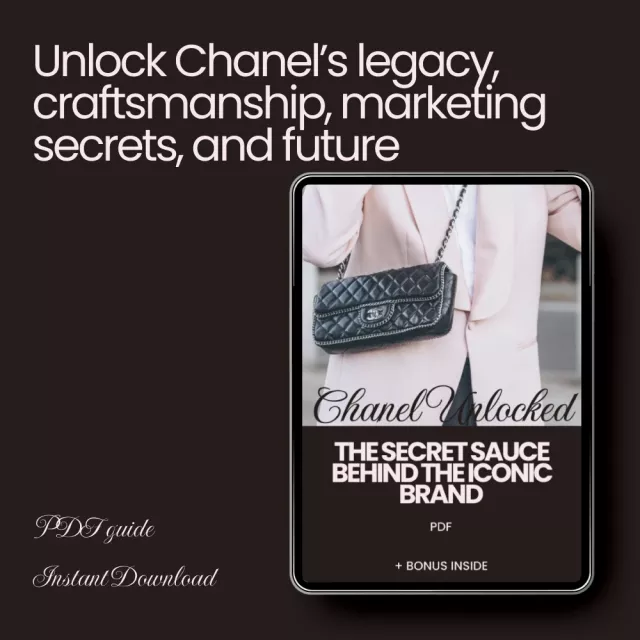
Product Overview
Unlock the world of timeless elegance with *Chanel Unlocked: The Secret Sauce Behind the Iconic Brand*. This exclusive guide offers an in-depth look at what makes Chanel different and how it became one of the most celebrated names in fashion history. From the revolutionary vision of Coco Chanel to the enduring influence of its signature styles, this eBook gives you unparalleled insight into the heritage, craftsmanship, marketing genius, and future of this iconic brand. Whether you’re a fashion enthusiast or an aspiring designer, this guide is your ultimate resource to understanding Chanel’s unparalleled appeal.
Key Features
- Chapter 1: The Legacy of Chanel – Dive deep into Coco Chanel’s life, how she changed the fashion world, and the signature styles that define the brand today.
- Chapter 2: The Chanel Difference – Style, Craft, and Experience – Explore the timeless elegance, materials, and craftsmanship behind Chanel’s most iconic pieces, like the Little Black Dress.
- Chapter 3: Marketing, Myth, and Modern Influence – Learn how Chanel built a lifestyle brand through celebrity influence, red carpet moments, and smart marketing strategies.
- Chapter 4: Future of Chanel & AI in Fashion – Discover how AI is revolutionizing luxury fashion and what it means for the future of Chanel and the fashion industry.
What Makes This Guide Different?
This guide isn’t just another overview of the Chanel brand. *Chanel Unlocked: The Secret Sauce Behind the Iconic Brand* offers a comprehensive analysis that goes beyond surface-level knowledge. With case studies, a deep dive into craftsmanship, and real-world examples, it’s perfect for anyone interested in the timeless style and business genius behind Chanel. Unlike other resources, this guide is designed to give you a holistic understanding of Chanel, from its inception to its modern-day influence on fashion. You’ll learn what makes Chanel different in terms of design, craftsmanship, and marketing, and how the brand continues to evolve with the times.
Who is This For?
This guide is perfect for:
- Fashion enthusiasts who want to understand what makes Chanel different from other brands.
- Aspiring designers looking for inspiration from a legacy of elegance and innovation.
- Marketing professionals seeking to learn the secrets behind Chanel’s powerful brand-building strategies.
- Anyone who appreciates the craftsmanship and beauty behind high-end fashion.
Practical Benefits
- Gain a deeper understanding of the Chanel brand, its rich history, and what makes it a lasting symbol of luxury.
- Discover valuable lessons in design, marketing, and business that can apply to your own career or brand.
- Explore the intersection of luxury fashion and modern technology, such as AI’s impact on personalized customer experiences.
- Learn the secrets behind some of the most iconic fashion pieces ever created, like the Little Black Dress.
Ready to Unlock Chanel’s Secrets?
Don’t miss out on this exclusive opportunity to delve into the world of Chanel. *Chanel Unlocked: The Secret Sauce Behind the Iconic Brand* is more than just a guide—it’s a comprehensive resource for anyone looking to understand what makes Chanel different and how this legendary brand continues to influence the fashion world today. Download your copy now and uncover the hidden details behind one of the most iconic brands in history!
SHIPPING
We are proud to offer international shipping services that currently operate in over 200 countries and islands world wide. Nothing means more to us than bringing our customers great value and service. We will continue to grow to meet the needs of all our customers, delivering a service beyond all expectation anywhere in the world.
Do you ship worldwide?
Yes. We provide free shipping to over 200 countries around the world. However, there are some locations we are unable to ship to. If you happen to be located in one of those countries we will contact you.
What about customs?
We are not responsible for any custom fees once the items have been shipped. By purchasing our products, you consent that one or more packages may be shipped to you and may get custom fees when they arrive to your country.
How long does shipping take?
Shipping time varies by location. These are our estimates:| Location | *Estimated Shipping Time |
|---|---|
| United States | 5-20 Business days |
| Canada, Europe | 5-20 Business days |
| Australia, New Zealand | 5-20 Business days |
| Central & South America | 5-25 Business days |
| Asia | 5-20 Business days |
| Africa | 5-25 Business days |
Do you provide tracking information?
Yes, you will receive an email once your order ships that contains your tracking information. If you haven’t received tracking info within 5 days, please contact us.
My tracking says “no information available at the moment”.
For some shipping companies, it takes 2-5 business days for the tracking information to update on the system. If your order was placed more than 5 business days ago and there is still no information on your tracking number, please contact us.
Will my items be sent in one package?
For logistical reasons, items in the same purchase will sometimes be sent in separate packages, even if you've specified combined shipping.
If you have any other questions, please contact us and we will do our best to help you out.
RETURNS
Order cancellation
All orders can be cancelled until they are shipped. If your order has been paid and you need to make a change or cancel an order, you must contact us within 12 hours. Once the packaging and shipping process has started, it can no longer be cancelled.
Refunds
Your satisfaction is our #1 priority. Therefore, you can request a refund or reshipment for ordered products if:
- If you did not receive the product within the guaranteed time (45 days not including 1-3 day processing) you can request a refund or a reshipment.
- If you received the wrong item you can request a refund or a reshipment.
- If you do not want the product you’ve received you may request a refund but you must return the item at your expense and the item must be unused.
We do not issue the refund if:
- Your order did not arrive due to factors within your control (i.e. providing the wrong shipping address)
- Your order did not arrive due to exceptional circumstances outside the control of cresteri.com (i.e. not cleared by customs, delayed by a natural disaster).
- Other exceptional circumstances outside the control of cresteri.com.
*You can submit refund requests within 15 days after the guaranteed period for delivery (45 days) has expired. You can do it by sending a message on Contact Us page
If you are approved for a refund, then your refund will be processed, and a credit will automatically be applied to your credit card or original method of payment, within 14 days.
Exchanges
If for any reason you would like to exchange your product, perhaps for a different size in clothing, you must contact us first and we will guide you through the steps.
Please do not send your purchase back to us unless we authorise you to do so.
Order cancellation
All orders can be cancelled until they are shipped. If your order has been paid and you need to make a change or cancel an order, you must contact us within 12 hours. Once the packaging and shipping process has started, it can no longer be cancelled.
Refunds
Your satisfaction is our #1 priority. Therefore, you can request a refund or reshipment for ordered products if:
- If you did not receive the product within the guaranteed time( 45 days not including 2-5 day processing) you can request a refund or a reshipment.
- If you received the wrong item you can request a refund or a reshipment.
- If you do not want the product you’ve received you may request a refund but you must return the item at your expense and the item must be unused.
We do not issue the refund if:
- Your order did not arrive due to factors within your control (i.e. providing the wrong shipping address)
- Your order did not arrive due to exceptional circumstances outside the control of cresteri.com (i.e. not cleared by customs, delayed by a natural disaster).
- Other exceptional circumstances outside the control of https://cresteri.com
*You can submit refund requests within 15 days after the guaranteed period for delivery (45 days) has expired. You can do it by sending a message on Contact Us page
If you are approved for a refund, then your refund will be processed, and a credit will automatically be applied to your credit card or original method of payment, within 14 days.
Exchanges
If for any reason you would like to exchange your product, perhaps for a different size in clothing. You must contact us first and we will guide you through the steps.
Please do not send your purchase back to us unless we authorise you to do so.
Customer Reviews
Write a Review
We Think You’ll Love
Top picks just for you















The three marketing pitfalls — trend-chasing, weak storytelling, fragmented brand identity — describe most brands' problems with surprising precision.
Buying into a story of heritage, luxury, and exclusivity rather than just a bag is the most honest thing any guide on Chanel has said.
The case study linking Audrey Hepburn's iconic moment in Breakfast at Tiffany's to a broader principle about how cultural context transforms a product into a symbol is the best illustration of why Chanel's red carpet strategy was never about coverage volume It's about narrative placement — and this guide explains the difference between those two approaches better than most marketing writing I've encountered on the topic.
I have a complicated relationship with Chanel — I grew up in a family that considered fashion frivolous, studied economics, and came to luxury goods late through a professional interest in brand equity and consumer behavior. What I found in this guide instead of surface-level brand admiration was a structural account of why Chanel operates as it does, organized across four chapters that move from historical context through craft philosophy into marketing strategy and finally into how AI is reshaping what the brand can do. The legacy chapter positioned Coco not as a fashion icon but as a systems thinker — someone who identified that the existing constraints on women's clothing were an opportunity rather than a tradition, and who redesigned the entire premise of luxury rather than merely competing within it. The craftsmanship section does something important: it grounds the quality argument in specific materials and processes rather than vague prestige language — high-quality tweeds, silks, and leathers; precise stitching; hand-finished details that add up to pieces designed for decades — these are observable, verifiable claims. The marketing chapter was where I found the most direct analytical value, particularly the three-failure model and the observation that Chanel sells a story of heritage, luxury, and exclusivity rather than a product; this is the kind of brand analysis that earns its conclusions rather than asserting them. The AI chapter surprised me — not because the applications covered were unfamiliar, but because they were connected to the brand's historical logic rather than grafted onto it, AI for trend forecasting mirrors what Coco did intuitively, and AI for material optimization is a natural extension of the craftsmanship philosophy. By the end I had a coherent model for why Chanel has maintained relevance for over a century and a vocabulary for applying those principles analytically — for someone who came in skeptical, that's a meaningful outcome.
Practical AI prompts pull the guide's attention away from the brand analysis right when it gets most interesting.
Both the Chanel suit and the costume jewelry are positioned here as expressions of the same design logic: opposite qualities held in deliberate balance — ease with elegance, playfulness with sophistication — rather than resolved in favor of either. The guide makes this logic visible across every chapter rather than just asserting it, which makes the content useful to anyone who wants to understand the brand analytically rather than just appreciate it aesthetically.
✨
The connecting thread from Coco's original philosophy — women shouldn't be restricted by stiff corsets or unnecessary frills — to modern Chanel's continued resistance to disposable fashion is drawn clearly across the guide without being labored. The point that focuses on enduring style rather than seasonal fads is not presented as conservative but as a deliberate competitive strategy that has compounded in brand equity over decades.
The blend of storytelling with data as a next step for aspiring fashion enthusiasts translates Chanel's intuitive genius into something learnable.
After a Chanel SA told me most buyers don't understand what they're actually paying for, I wanted a guide that explained the brand's enduring relevance rather than just describing it. The first two chapters delivered that grounding with real substance — the legacy section's treatment of Coco as a revolutionary, and the craftsmanship section's specificity about tweeds, silks, precise stitching, and hand-finished details, together form a foundation most short-form brand content never bothers to build. The celebrity influence content is also handled thoughtfully, particularly the distinction between viral visibility and cultural permanence as strategic objectives. Where the guide loses its footing is in the shift from brand philosophy into AI applications — a tonal break that the writing doesn't fully recover from, and where the practical prompts feel misplaced in an otherwise flowing narrative. The closing synthesis that Chanel's magic is the fusion of timeless design, craftsmanship, and storytelling would have landed harder if the AI chapter had been better integrated rather than appended. The foundation here is genuinely strong; the execution just runs out of discipline before the final chapter.
Predicting which classic silhouettes will remain in demand is the kind of foresight this guide helps you develop rather than just describe.
The closing observation that Chanel's magic is the fusion of timeless design, meticulous craftsmanship, and compelling storytelling earns its simplicity because the preceding chapters have built the case for each of those three elements individually. Guides that open with a summary and then demonstrate it are common. Guides that build toward a synthesis and then land it cleanly are worth returning to.